Georden Jones, Founder, The Peer Review · Last updated: August 9, 2026
The Short Answer
Food-grade silicone is a reasonable, well-regulated choice for baking mats, moulds, utensils, and storage: stable, flexible, heat- and cold-tolerant, and treated as safe for normal use by the FDA, Health Canada, and European regulators [1][2]. It is not, however, perfectly inert, and it is not “natural.” Under high heat (above roughly 230°C/450°F) and with fatty or oily foods, silicone can release small amounts of siloxanes (the building-block molecules it is made from) into food [2][3]. For most everyday uses, well below those temperatures, migration is low, and quality matters a lot: high-grade platinum-cured silicone that has been properly cured leaches far less than cheap, poorly cured product [2][3]. The honest position is “a good, low-risk material used within its limits,” with a dash of humility about the long-term data, not “perfectly inert forever.”
Quick Answer: Is Food-Grade Silicone Safe?
- Normal use (below ~220°C, non-greasy or brief contact): low migration, regulated as safe [1][2].
- The catch: high heat plus fatty/oily foods increases siloxane migration; cheap, poorly cured silicone leaches more [2][3].
- It is synthetic, not natural: made from silicon (from sand) plus carbon and oxygen. That does not make it unsafe; it means “natural” marketing is beside the point.
- Evidence Rating: General Consensus. Food-grade silicone is broadly accepted as safe for intended use, with well-documented caveats around heat, fat, and quality, and some honest uncertainty about long-term low-level exposure.
Table of Contents
- What Silicone Really Is
- Where Silicone Shows Up
- How It Interacts With Your Body
- The Honest Catch: Heat, Fat, and Quality
- “Is Silicone Natural?” (No, and That’s Fine)
- How to Choose and Use Silicone
- FAQ
- The Bottom Line
- References
What Silicone Really Is
Silicone is a synthetic polymer built on a backbone of silicon and oxygen (a siloxane chain), with carbon-based groups attached: a rubber-like material prized for staying flexible from freezer to hot oven [2]. The silicon comes from silica (sand/quartz), which is where the “sand-based, basically natural” marketing comes from, but the finished material is manufactured, not found in nature.
The quality distinction that matters most is how it was cured. Platinum-cured (platinum-catalysed) silicone is the higher-grade, more stable type used in medical and premium food products; peroxide-cured silicone is cheaper and more prone to leaving residues [2][3]. When people say “food-grade silicone is safe,” they are mostly describing well-made, properly cured platinum silicone used within its temperature rating.
Where Silicone Shows Up
Silicone has spread through the kitchen because it is durable, non-stick-ish, and tolerates temperature extremes:
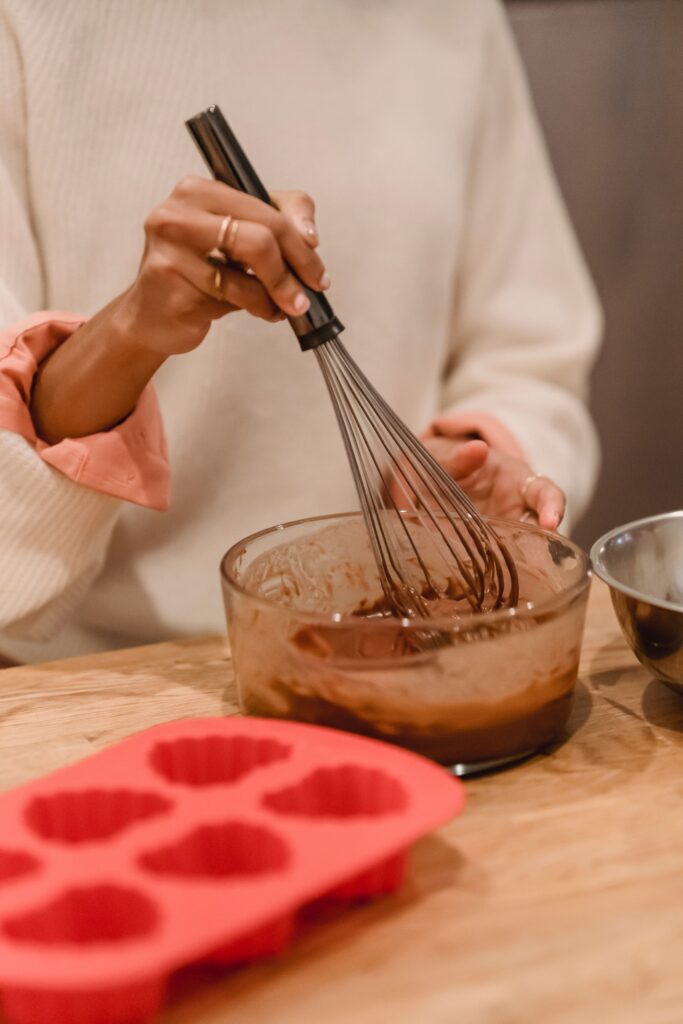
- Bakeware and baking aids: baking mats, muffin and loaf moulds, cake pans, macaron mats.
- Utensils: spatulas, spoons, whisks (often silicone over a metal core), brushes.
- Storage: stretch lids, storage-bag alternatives, container seals and gaskets.
- Baby and personal items: bottle nipples, teethers, plates, and (outside food) menstrual cups.
- Seals and gaskets: the rings in glass and stainless containers, pressure cookers, and travel mugs.
Most of these involve either low heat, brief contact, or non-fatty foods: the conditions under which silicone performs best.
How It Interacts With Your Body
The exposure pathway is migration of siloxanes (small, sometimes cyclic molecules like D4, D5, D6) from the silicone into food, which are then eaten [2][3]. Two conditions drive it: heat and fat/alcohol. Migration testing shows that fatty and alcoholic foods pull out the most, while watery and milk-based foods pull out very little; one study found the highest siloxane migration in a meat loaf baked in a commercial mould, while milk-based food was near non-detectable even at high fat [3]. Migration rises meaningfully once temperatures exceed roughly 230°C/450°F [2].
Two things keep this in proportion. First, under normal use (moderate oven temperatures, brief or non-greasy contact), measured migration is low, which is why regulators clear food-grade silicone for repeated food contact [1][2]. Second, curing and quality strongly affect it: properly tempered (post-cure baked) moulds leached far less than non-tempered ones, and trace siloxane and platinum migration shows up mostly in lower-grade silicone and during the first few uses [3]. The honest caveat is that the long-term health effects of ingesting low levels of siloxanes are not fully characterised, so “low migration under normal use” is the accurate claim, not “zero, guaranteed harmless forever.”
The Honest Catch: Heat, Fat, and Quality
Safer material, used within limits: here is where the limits are:
- High heat is the main lever. Staying under the product’s rated temperature (often ~220°C/428°F) keeps migration low; blasting silicone under a broiler or over an open flame is outside its design and increases siloxane release [2].
- Fatty and oily foods migrate more. Greasy, buttery, or alcoholic contact pulls out more siloxane than watery foods [3]. For very fatty high-heat baking, that is worth knowing.
- Cheap silicone is the real weak point. Poorly cured or filler-laden silicone leaches more, including in early uses [3]. A common home check is the “pinch test”: twisting a piece to see if it shows white streaks, which can indicate fillers, though it is a rough heuristic, not a lab test.
- Break it in. Because early uses can release the most, baking a new item empty (“tempering” it) before first food use is a sensible precaution [3].
“Is Silicone Natural?” (No, and That’s Fine)
Silicone is frequently marketed as a “natural, sand-based” alternative to plastic. It is a different and generally more heat-stable material than most plastics, but it is a synthetic polymer, not a natural product [2]. That distinction matters only because “natural” is doing persuasive work it should not. A material’s safety comes from how it behaves, not from where it sits on the natural-versus-synthetic line. This is the naturalistic fallacy we cover elsewhere, and the same point as Natural vs. Man-Made: judge silicone on its migration data and temperature limits, not on a “sand-based” story. By that honest standard, food-grade silicone holds up well for intended use.
How to Choose and Use Silicone
- Buy food-grade, platinum-cured silicone from reputable brands; look for LFGB or FDA food-contact compliance [2].
- Respect the temperature rating. Keep it under the stated max (commonly ~220°C); do not use it under a broiler or on direct flame [2].
- Go easy on very fatty, very hot combinations. For greasy high-heat baking, glass or metal bakeware is a lower-migration choice [3].
- Temper new items. Bake a new mould empty before first food use to reduce early siloxane release [3].
- Skip suspiciously cheap silicone. If it smells strongly, feels flimsy, or streaks white when twisted, treat it as low quality [3].
FAQ
Is food-grade silicone toxic?
Under normal use it releases only small amounts of siloxanes and is regulated as safe for repeated food contact [1][2]. It is not perfectly inert, and high heat with fatty food increases migration, so it is best described as low-risk within its limits rather than “totally inert.”
Does silicone leach chemicals into food?
It can leach small amounts of siloxanes, most into fatty and alcoholic foods and at high temperatures; watery foods pull out very little [3]. Staying under the rated temperature and using quality silicone keeps migration low.
Is silicone safer than plastic?
Generally it is more heat-stable and does not contain BPA or phthalate plasticisers, which is a real advantage. But “safer” does not mean “inert”. It has its own heat and fat limits [2][3].
Is silicone natural because it’s made from sand?
No. The silicon originates from sand, but silicone is a manufactured synthetic polymer [2]. Its safety comes from its behaviour, not from a “natural” label.
What temperature is safe for silicone?
Stay under the product’s rating, commonly around 220°C/428°F. Migration of siloxanes rises once you exceed roughly 230°C/450°F, and broiler/open-flame use is outside its design [2].
The Bottom Line
Food-grade silicone is a solid, well-regulated material for baking, utensils, and storage, with low migration under normal use, a fair upgrade over many plastics, without their plasticiser chemistry [1][2]. Keeping it honest means naming the limits: high heat plus fatty foods raises siloxane migration, cheap or poorly cured silicone leaches more, the long-term data on low-level siloxane intake is incomplete, and, despite the marketing, it is synthetic, not natural [2][3]. Buy quality platinum-cured silicone, respect its temperature rating, favour glass or metal for very fatty high-heat baking, and it earns its place as a low-risk, convenient material used within its design.
Stay curious, stay critical.
Georden
References
- U.S. FDA / regulatory overview of silicone for repeated food contact (21 CFR 177.2600; GRAS status). Summary via Plasticproof.
- “Is Silicone Safe for Cooking? Evidence-Based Guide (heat limits, curing, siloxanes).” Cupindy / evidence summary.
- Helling R, et al. “Migration behaviour of silicone moulds in contact with different foodstuffs.” PubMed.
Georden Jones is the founder of The Peer Review. Read the full story.